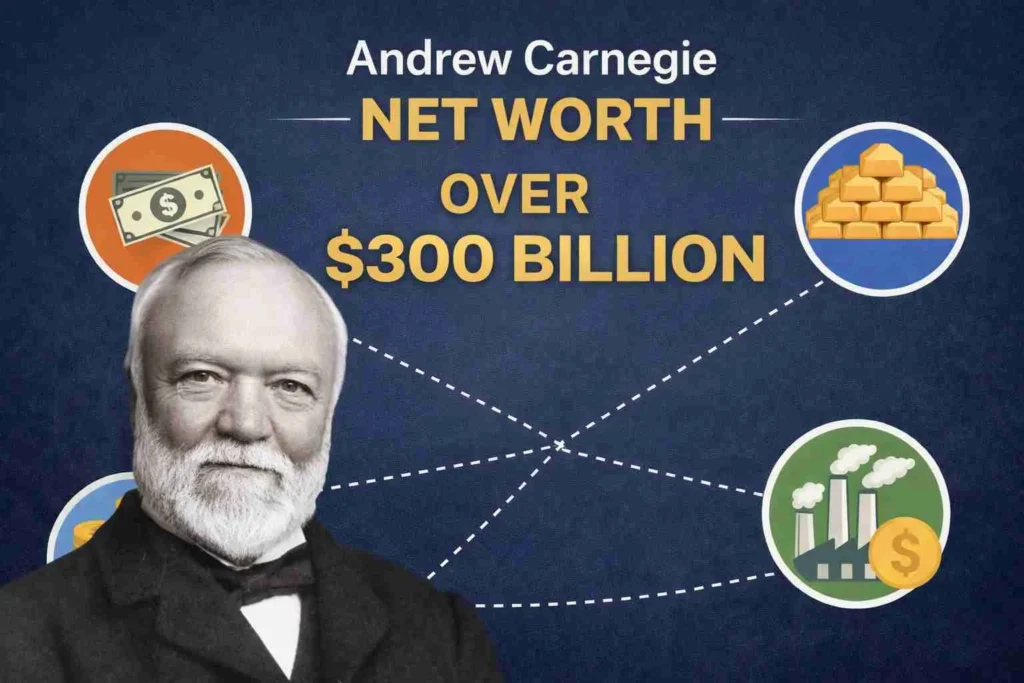
Scottish-American industrialist and philanthropist Andrew Carnegie amassed a net worth of approximately $480 million at the time of his death in 1919, which would be equivalent to over $310 billion today when adjusted for inflation, primarily from his steel empire.
Andrew Carnegie, one of history’s most renowned industrialists, transformed the American steel industry in the late 19th and early 20th centuries, amassing immense wealth that made him one of the richest men of his era.
Born in 1835 in Scotland, Carnegie immigrated to the United States and leveraged his vision, business acumen, and innovation to build the Carnegie Steel Company, which he later sold to J.P. Morgan for over $480 million a staggering fortune at the time.
Today, historians and financial analysts estimate that adjusted for inflation, Carnegie’s net worth would exceed $350 billion, placing him among the wealthiest individuals in modern history.
Beyond his financial success, Carnegie is celebrated for his philanthropic legacy, having donated more than $350 million to establish libraries, schools, and cultural institutions worldwide, embodying his famous belief that “the man who dies rich dies disgraced.”
His story remains a benchmark of entrepreneurship, wealth creation, and socially responsible giving.
Andrew Carnegie Net Worth Bio Data Table
| Attribute | Details |
|---|---|
| Full Name | Andrew Carnegie |
| Date of Birth | November 25, 1835 |
| Age (at death) | Died August 11, 1919 (aged 83) |
| Place of Birth | Dunfermline, Scotland, UK |
| Nationality | Scottish-American |
| Height | ~5 ft 7 in (170 cm) (estimated) |
| Weight | ~68–70 kg (150 lbs) (estimated) |
| Health Conditions | Died of pneumonia at age 83; no widely documented chronic illnesses |
| Religion | Raised Presbyterian |
| Education | Basic formal education in Scotland; largely self-educated; avid reader and lifelong learner |
| Sports | Not professionally associated with sports |
| Zodiac Sign | Sagittarius |
| Marriage / Relationship Status | Married Louise Whitfield (since 1887 until his death) |
| Children | One child (Margaret Carnegie Miller) |
| Net Worth | Estimated ~$310 billion (adjusted for 2026 USD) historically one of the richest men in history |
| Social Media Accounts | N/A (historical figure) |
| Still Alive | No — died 1919 |
| Famous For | Industrialist, steel magnate, philanthropist; founder of Carnegie Steel Company; built vast wealth in the U.S. steel industry during the late 19th century; major philanthropist funding libraries, education, and peace initiatives worldwide |
Who Is Andrew Carnegie?
Andrew Carnegie was a Scottish-born industrialist who transformed the steel industry in America during the Gilded Age. Born into a working-class family, he emigrated to the United States at age 12. Carnegie began working in factories and as a railroad office boy, learning the value of hard work and seizing opportunities wherever they appeared.
Through early investments in railroads and strategic business decisions, he built the foundation for what would become Carnegie Steel Company. His story is one of ambition, innovation, and financial strategy that elevated him from modest beginnings to immense wealth.
Net Worth Overview
Andrew Carnegie’s wealth at the time of selling Carnegie Steel in 1901 was approximately $480 million. Adjusted for today’s economy, financial historians estimate his modern net worth to be around $300–$310 billion. This makes him one of the richest people in history when measured relative to the global economic scale.
Disclaimer: Net worth figures are estimates based on publicly available data and may vary.
Net Worth Growth Timeline
Before Fame
Carnegie earned his first significant income from railroad investments and entrepreneurial ventures, which provided capital for future business expansion.
Breakthrough Phase
By the 1870s and 1880s, Carnegie Steel had become the leading steel producer in the United States due to efficiency, scale, and integration of production stages.
Peak / Recent Years
The sale of Carnegie Steel to J.P. Morgan in 1901 for $480 million marked Carnegie’s financial peak, translating to hundreds of billions in today’s dollars.
Main Sources of Income
Core Profession Income
The majority of Carnegie’s wealth came from ownership and leadership of Carnegie Steel Company.
Business Revenue
His steel empire generated massive revenues as the U.S. industrial sector expanded in the late 19th century.
Other Income Streams
- Railroad investments
- Ironworks and bridge production
- Bonds and early financial instruments
Business Strategy Behind the Wealth
Carnegie’s strategy centered on:
- Vertical integration – controlling every stage of steel production
- Efficiency – minimizing costs through technology and operations
- Market dominance – consolidating competitors to increase profits
Awards & Achievements and Financial Impact
Carnegie’s accomplishments include:
- Building the largest steel company in the U.S.
- Innovating business practices that shaped the industrial sector
- Funding institutions and philanthropic programs that left a lasting legacy
Assets & Lifestyle
Real Estate
Carnegie owned multiple grand estates, though he often used wealth for institutional purposes rather than personal extravagance.
Luxury & Investments
While he enjoyed a comfortable life, his main focus remained investments and philanthropy. His assets included art, real estate, and long-term ventures in education and research.
Net Worth Comparison (Peers / Industry)
Carnegie is often compared to other industrial magnates of his time, including:
- John D. Rockefeller
- Cornelius Vanderbilt
These comparisons highlight his position as one of the richest figures in history relative to the economy of his era.
Controversies, Challenges & Financial Risks
Carnegie faced criticism for harsh labor practices, notably during the Homestead Strike. His aggressive business methods and focus on profit over labor welfare caused tension and public scrutiny.
Philanthropy & Social Impact
Carnegie believed that the wealthy should use their fortunes for the public good. He donated over $350 million to libraries, education, peace initiatives, and research, leaving a philanthropic legacy that continues today.
How Andrew Carnegie Makes Money Outside Core Profession
Beyond steel, Carnegie earned income through:
- Strategic financial investments
- Railroad securities
- Industrial holdings and allied ventures
These activities complemented his primary fortune and diversified his wealth.
Future Net Worth Projection
As a historical figure, Carnegie’s net worth remains static, but modern financial analyses continue to reinterpret his wealth in terms of inflation, GDP share, and economic impact, highlighting his lasting influence.
Frequently Asked Questions
How much was Andrew Carnegie worth at his peak?
Estimated at $300–$310 billion in today’s dollars.
Did Carnegie donate most of his wealth?
Yes, he gave away about 90% of his fortune to philanthropic causes.
Was he the richest man in history?
He is among the wealthiest figures, often compared with Rockefeller depending on calculation methods.
What did he do after selling Carnegie Steel?
He devoted his life to philanthropy and establishing educational and peace institutions.
What was Carnegie’s main source of wealth?
Carnegie Steel Company, along with investments in railroads and industrial ventures.
Conclusion
Andrew Carnegie’s life exemplifies the rise from immigrant beginnings to one of the most remarkable fortunes in history. His wealth, combined with extensive philanthropy, leaves a legacy that continues to inspire financial enthusiasts, historians, and the general public.

Chris Woakes blends his love for sports and wordplay, delivering a witty, pun-filled style that turns everyday cricket anecdotes and life observations into clever, lighthearted storytelling. His humor is sharp yet approachable, making readers laugh while appreciating his clever linguistic twists.