
Definition:
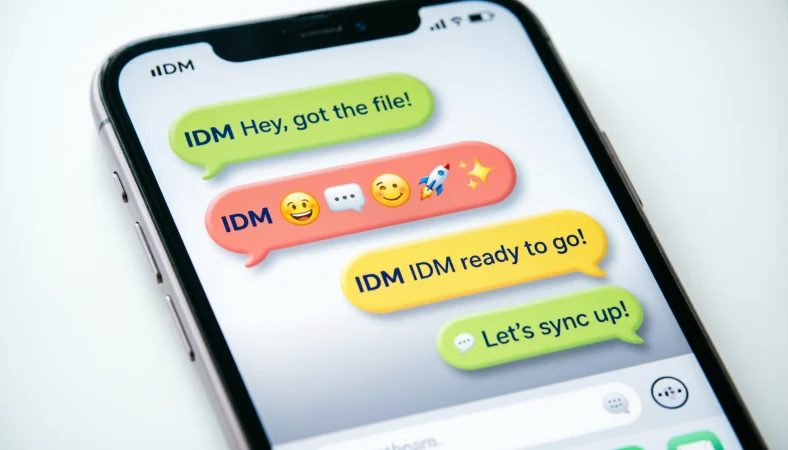
IDM stands for “I don’t mind”. It is a popular abbreviation used in text messages, social media, and online chats to indicate that the speaker is indifferent, neutral, or okay with a suggestion or decision.
In today’s fast-moving digital world, abbreviations like “IDM” are used across different platforms and industries, often leaving people confused about their exact meaning. Whether you’ve seen it in chats, social media, or technical discussions, understanding what “IDM” stands for depends heavily on the context in which it’s used.
Most commonly, IDM can refer to “Internet Download Manager,” a popular software tool, or “Identity Management,” a concept widely used in IT and cybersecurity.
The importance of knowing the correct meaning of IDM lies in clear communication and accurate understanding, especially when dealing with technology or online conversations. By exploring its different interpretations and real-world usage, you can avoid misunderstandings and confidently use the term in the right situation.
Origin of IDM
IDM, as an abbreviation, emerged with the rise of digital communication and texting culture. As smartphones, instant messaging apps, and social platforms became widely used, people sought faster ways to express themselves.
- Time-saving: Typing “I don’t mind” repeatedly in casual conversations became tedious.
- Internet culture: Shortened phrases like LOL (“laugh out loud”), BRB (“be right back”), and IDK (“I don’t know”) popularized IDM.
- Global usage: While IDM started in English-speaking online communities, it is now recognized worldwide due to social media and messaging apps.
In short, IDM originated as a convenience tool for informal digital communication.
Popularity and Real-World Usage
IDM is widely used in texting, chat apps, and social media posts. Its popularity lies in its simplicity and versatility. It can convey:
- Indifference: You genuinely don’t have a preference.
- Agreement: You accept someone’s choice without objection.
- Casual politeness: You’re okay with whatever the other person suggests.
Example platforms where IDM is commonly seen:
- Facebook Messenger
- Instagram DMs
- Twitter/X
- TikTok comments
It’s often paired with emojis to add tone, such as 🙂, 😅, or 😎, depending on context.
Examples of IDM in Context
Using IDM correctly depends on tone, context, and the relationship between communicators. Here are some examples:
| Scenario | Example Text | Tone |
| Choosing a restaurant | “Do you want pizza or burgers tonight?” → “IDM 😄” | Friendly/Neutral |
| Deciding on a movie | “Should we watch a comedy or action film?” → “IDM, you pick 🎬” | Casual/Polite |
| Dismissing options | “Do you want to go hiking?” → “IDM, not really feeling it 😅” | Neutral/Dismissive |
| Work setting | “Should we schedule the meeting for 2 PM or 3 PM?” → “IDM, either works for me” | Professional/Polite |
Tip: Context matters. In a casual chat with friends, IDM is relaxed. In professional messaging, it’s better to add clarifying words to avoid appearing indifferent or uncooperative.
Tone and Variations
IDM can convey subtle differences based on accompanying punctuation, emojis, or phrasing:
- Friendly: “IDM 🙂”
- Neutral: “IDM, you decide.”
- Dismissive/Negative: “IDM… whatever.”
Using IDM responsibly ensures your communication doesn’t come across as rude or apathetic.
Comparison with Related Abbreviations
IDM is often confused with similar abbreviations. Here’s a comparison:
| Abbreviation | Meaning | Difference from IDM |
| IDK | I don’t know | Expresses lack of knowledge rather than indifference |
| IDC | I don’t care | Stronger, can sound rude compared to IDM |
| IMO | In my opinion | Shares a personal opinion, not indifference |
| IKR | I know, right | Agreement rather than neutrality |
| SMH | Shaking my head | Expresses disapproval, not indifference |
Key takeaway: IDM is polite and neutral, unlike IDC or SMH, which carry stronger emotions.
Alternate Meanings of IDM
While the most common meaning of IDM is “I don’t mind”, it can also stand for:
- Intelligent Dance Music – a genre of electronic music featuring complex rhythms and melodies.
- Internet Download Manager – a software tool for downloading files faster from the internet.
- Integrated Device Manufacturer – companies that design and manufacture integrated circuits.
Context is key: Online chats usually mean “I don’t mind,” while music discussions or tech forums may refer to other meanings.
Polite or Professional Alternatives to IDM
In formal or professional settings, you may want alternatives to IDM that convey neutrality without seeming casual or indifferent:
- “Either option works for me.”
- “I’m fine with your choice.”
- “I have no preference; please decide.”
- “I’m flexible with whichever you prefer.”
These alternatives maintain politeness and clarity while avoiding the informality of IDM.
Tips for Using IDM Correctly
- Use in casual conversations: Best suited for texting friends or informal messaging.
- Pair with emojis: Adds tone and warmth to prevent misinterpretation.
- Avoid in formal emails: Use full phrases instead for professionalism.
- Clarify if necessary: If tone is unclear, add a short explanation.
- Observe context: Recognize when IDM might be misread as disinterest.
FAQ:
1. What does IDM mean in texting?
IDM means “I don’t mind” and is used to show neutrality or agreement in casual conversations.
2. Is IDM the same as IDC?
Not exactly. IDC means “I don’t care” and can sound stronger or dismissive. IDM is more neutral and polite.
3. Can IDM be used in professional messages?
Yes, but it’s better to use full phrases like “I’m fine with your choice” for clarity and professionalism.
4. Are there emojis commonly paired with IDM?
Yes. 🙂, 😅, 😎, and 👍 are often used to add tone or friendliness.
5. Where is IDM commonly used?
On social media platforms, instant messaging apps, and texting between friends.
6. Can IDM have negative connotations?
Yes, if used with ellipses (…) or a flat tone, it can appear dismissive or uninterested.
7. What are some alternatives to IDM?
“Either option works for me,” “I have no preference,” or “I’m flexible” are polite alternatives.
8. Are there other meanings of IDM?
Yes. IDM can also mean Intelligent Dance Music, Internet Download Manager, or Integrated Device Manufacturer, depending on context.
Conclusion
In conclusion, “IDM” is a versatile abbreviation with multiple meanings depending on the context, such as Internet Download Manager, Intelligent Dance Music, or Identity Management. Understanding the intended usage is key to interpreting it correctly, especially in conversations related to technology, music, or business systems.
To avoid confusion, always consider where and how the term is being used. Whether you’re talking about software, a music genre, or digital security, “IDM” carries different but important meanings that reflect its context.