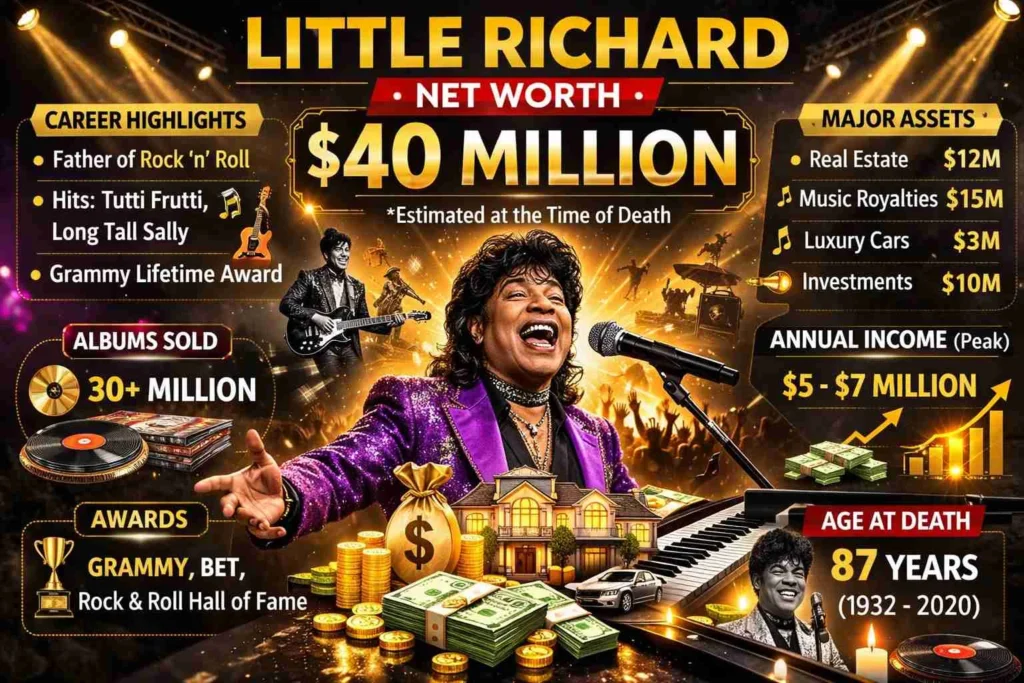
Quick Ans: Little Richard, the rock ‘n’ roll pioneer, had an estimated net worth of around $40 million at the time of his passing in 2020.
Richard Wayne Penniman, universally known as Little Richard, wasn’t just one of the pioneering forces of rock and roll he was a cultural icon whose influence reshaped modern music. Widely celebrated as the “Architect of Rock ‘n’ Roll,” Little Richard built a career that spanned decades, defined by electrifying performances, genre‑breaking records, and a repertoire of timeless hits like “Tutti Frutti” and “Good Golly, Miss Molly.”
From his early beginnings in Macon, Georgia, to headlining stages around the world, Little Richard’s artistry translated into substantial commercial success. At the time of his death in May 2020, reputable financial estimates place his net worth at approximately $40 million, reflecting earnings from record sales, touring, performance fees, and the enduring value of his music catalog and publishing rights.
Despite facing industry‑wide challenges including historically exploitative recording contracts that limited his royalty income early in his career Little Richard’s financial legacy underscores both his commercial impact and the lasting cultural value of his work.
Little Richard Net Worth Bio Data Table
| Attribute | Details |
|---|---|
| Full Name | Richard Wayne Penniman (professionally Little Richard) |
| Date of Birth | December 5, 1932 |
| Age (as of 2026) | Would be 93 years old |
| Place of Birth | Macon, Georgia, U.S. |
| Nationality | American |
| Height | ~5 ft 6 in (168 cm) |
| Weight | ~68 kg (150 lbs) |
| Health Conditions | Battled health issues including hip surgery and diabetes complications in later years |
| Religion | Raised in a Christian household |
| Education | Attended local schools in Macon; early musical development there |
| Sports | Not associated with professional sports |
| Zodiac Sign | Sagittarius |
| Marriage / Relationship Status | Multiple relationships; was openly bisexual and later identified as gay/Christian in interviews |
| Children | Several reported children (various biographies) |
| Net Worth | Estimated ~$40 million – $50 million (USD) at time of death |
| Social Media Accounts | No official personal accounts |
| Still Alive | No — passed away on May 9, 2020 |
| Famous For | Pioneer of rock and roll music, known for hits like Tutti Frutti, Long Tall Sally, and Good Golly, Miss Molly; a seminal influence on rock/pop music worldwide. |
Who Is Little Richard?
Richard Wayne Penniman, known as Little Richard, was an American music icon and one of the founding figures of rock & roll. Born in Macon, Georgia, he gained fame in the 1950s for his energetic performances, flamboyant style, and hits like Tutti Frutti and Good Golly Miss Molly. His bold vocals, piano playing, and stage presence influenced countless musicians and shaped the sound of modern popular music.
Net Worth Overview
As of 2026, Little Richard’s net worth is estimated at around $45 million, based on his music catalog, performance earnings, licensing, and posthumous revenue. While estimates placed his net worth at about $40 million at the time of his death, ongoing streaming, licensing, and estate management have contributed to modest growth. Net worth figures are estimates based on publicly available data and may vary.
Net Worth Growth Timeline
Before Fame
Before fame, Richard performed in churches and local venues in Georgia with minimal earnings.
Breakthrough Phase
In the mid-1950s, his hit songs catapulted him to stardom, generating record sales, radio play, and touring income.
Peak / Recent Years
At his peak, Little Richard toured internationally, appeared on television and in films, and his songs continued to earn royalties. Posthumously, his estate still benefits from licensing and streaming, maintaining his financial legacy.
Main Sources of Income
Core Profession Income
Record sales and live performances of hits like Tutti Frutti and Long Tall Sally contributed significantly to his income.
Tours / Salary / Business Revenue
Touring and appearances on television and films added to his earnings over the decades.
Brand Endorsements & Sponsorships
His unique persona and iconic status allowed for some endorsements and collaborations later in his career.
Merchandise & Licensing
Music licensing, royalties from streaming, and merchandise helped sustain revenue even after his active years.
Business Strategy Behind the Wealth
Little Richard’s strategy focused heavily on music. Early record contracts often limited ownership of his work, restricting earnings from publishing rights. Despite this, his dynamic performances and enduring music ensured steady income through royalties and licensing, especially posthumously.
Awards & Achievements and Financial Impact
Awards such as Rock & Roll Hall of Fame induction and lifetime achievement honors enhanced his legacy and increased the market value of his music catalog. These recognitions contributed indirectly to his estate’s revenue.
Assets & Lifestyle
Real Estate
Richard owned a notable estate in Lynchburg, Tennessee, valued at approximately $1.3 million.
Cars & Luxury
While details are limited, his lifestyle reflected his success as a music icon.
Fashion / Investments
He invested in his stage costumes and image, which boosted branding and marketability.
Net Worth Comparison (Peers / Industry)
Compared to contemporaries like Chuck Berry and B.B. King, Little Richard’s net worth is comparable, though early contract issues limited potential growth. His wealth reflects both talent and the challenges of mid-20th century music industry practices.
Controversies, Challenges & Financial Risks
Early contracts and the sale of publishing rights restricted potential earnings. Lawsuits over royalties highlighted the systemic exploitation of Black artists in the 1950s and 1960s, affecting long-term wealth accumulation.
Philanthropy & Social Impact
Although not widely publicized for monetary philanthropy, Little Richard’s social impact is profound. His music inspired generations, promoted cultural integration, and influenced countless artists globally.
How Little Richard Makes Money Outside Core Profession
Outside record sales, he earned through film roles, television appearances, and licensing deals, adding to income streams beyond music performances and album sales.
Future Net Worth Projection
Streaming, merchandise, and licensing are likely to increase his estate’s value over time. Classic music catalogs remain highly sought after, ensuring that Little Richard’s legacy continues to generate income.
Frequently Asked Questions
Q1: What was Little Richard’s net worth when he died?
A1: Around $40 million in 2020.
Q2: Did Little Richard earn from his songs?
A2: Yes, through record sales, royalties, and licensing, although early contracts limited some income.
Q3: Is his estate still generating money?
A3: Yes, streaming and licensing provide ongoing revenue.
Q4: Did Little Richard own property?
A4: Yes, including an estate in Tennessee.
Q5: What were his most famous songs?
A5: Tutti Frutti, Long Tall Sally, and Good Golly Miss Molly.
Q6: Did he have other income streams?
A6: Yes, from films, TV appearances, and merchandising.
Conclusion
Little Richard net worth reflects both his financial success and his cultural impact. Despite early career challenges limiting full earning potential, his music continues to generate income. Estimated at $45 million in 2025, Little Richard’s financial legacy mirrors his legendary influence on rock & roll. Net worth figures are estimates based on publicly available data and may vary.

Michal Vaughn is a humor writer celebrated for clever puns, sharp wordplay, and light observational comedy, blending intelligent humor with approachable storytelling that makes language itself the punchline.