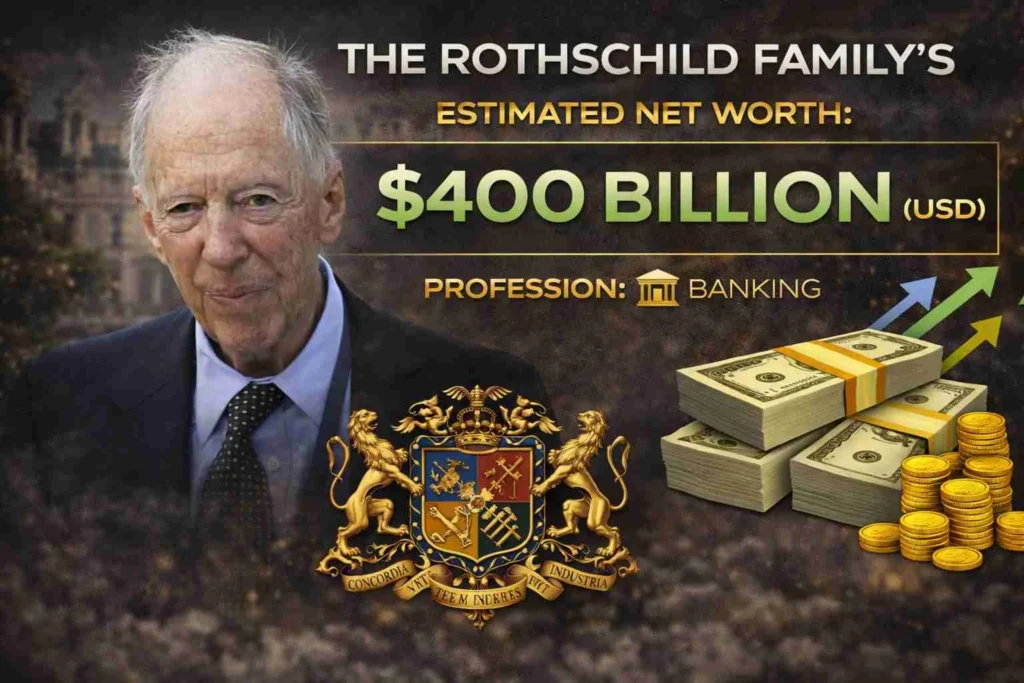
The Rothschild family’s estimated net worth is around $400 billion USD, making them one of the wealthiest families in history.
The Rothschild family net worth has fascinated historians, economists, and finance enthusiasts for more than two centuries. Known as one of the most powerful banking dynasties in modern history, the Rothschilds built an international financial empire that reshaped European banking, government finance, and global investments.
Originating in 18th-century Germany, the dynasty was founded by Mayer Amschel Rothschild, who established a banking house in Frankfurt. His five sons later expanded the family’s financial network across major European capitals including London, Paris, Vienna, Naples, and Frankfurt creating what many historians consider the world’s first multinational banking system.
Today, estimating the Rothschild family fortune is complex because the wealth is distributed across numerous descendants, private trusts, investment firms, and family-controlled companies. Most credible financial researchers estimate the Rothschild family net worth in 2026 to be between $400 billion and $1 trillion collectively, though exact numbers remain private due to the family’s extensive use of private banking structures and diversified holdings.
“Net worth figures are estimates based on publicly available data and may vary.”
Rothschild Family Net Worth Bio Data Table
| Attribute | Details |
|---|---|
| Family Name | Rothschild Family |
| Origin | Frankfurt, Germany |
| Founded By | Mayer Amschel Rothschild (18th century banking pioneer) |
| Founded | Late 1700s |
| Nationality / Presence | Europe (UK, France, Germany, Austria) and global financial influence |
| Profession / Business | Banking dynasty, investment banking, finance, asset management |
| Net Worth (2025–2026 estimate) | ~$400 billion USD combined family wealth (commonly cited estimate) |
| Other Estimated Range | Some analysts estimate $20B–$100B+ because wealth is private and divided among many descendants |
| Main Sources of Wealth | Investment banking (Rothschild & Co), wealth management, vineyards (Château Lafite Rothschild, Château Mouton Rothschild), real estate, art collections, and global investments |
| Historical Importance | Built one of the most powerful banking empires in Europe; financed governments, railroads, and major industrial projects during the 19th century |
| Key Modern Businesses | Rothschild & Co (investment bank), wine estates, asset management firms, private investment funds |
| Notable Members | Nathaniel Rothschild, David de Rothschild, Jacob Rothschild |
| Famous For | One of the most influential financial dynasties in modern history |
| Status | Family wealth spread across hundreds of descendants worldwide |
Who Is the Rothschild Family?
The Rothschild family is widely regarded as the most influential banking dynasty in European history. Their story began in the Jewish ghetto of Frankfurt in the 18th century.
The family patriarch, Mayer Amschel Rothschild, started as a coin dealer and financial agent for German royalty. Through careful networking, financial intelligence, and strategic lending, he developed relationships with powerful European aristocrats.
Understanding the importance of geographic diversification, he sent his five sons to establish banking operations across Europe:
- Frankfurt
- London
- Paris
- Vienna
- Naples
This network enabled the Rothschild family to move money, gold, and government bonds across borders faster than competitors. At a time when information traveled slowly, the family’s courier system provided them with financial intelligence days before rival bankers.
Their banking houses financed:
- European governments
- War efforts
- Railways
- Infrastructure projects
- Industrial expansion
This strategic position helped the family accumulate vast wealth and influence during the 19th century.
Net Worth Overview
Estimating the Rothschild family net worth is uniquely difficult because the wealth is distributed among hundreds of descendants and private financial entities.
Unlike modern billionaires whose fortunes are tied to public companies, the Rothschilds historically maintained private ownership structures.
Estimated Collective Wealth
| Category | Estimated Value |
|---|---|
| Banking & Financial Firms | $100B+ |
| Private Investments | $150B+ |
| Real Estate & Land | $50B+ |
| Art, Wine & Collectibles | $20B+ |
| Generational Trust Wealth | $100B+ |
| Estimated Total Net Worth (2026) | $400B – $1 Trillion |
The family’s wealth is spread across financial institutions such as Rothschild & Co, private equity funds, vineyards, real estate portfolios, and long-term investment trusts.
Because many holdings remain private, precise valuations are difficult to confirm.
Net Worth Growth Timeline
Before Fame
The Rothschild fortune began modestly in the mid-1700s.
Mayer Amschel Rothschild initially worked as a merchant dealing in rare coins and antiques. His expertise in numismatics attracted wealthy collectors and aristocrats.
This business provided his first connections to European nobility.
Breakthrough Phase
The family’s financial breakthrough occurred during the early 1800s.
By placing his sons in major European capitals, Mayer Rothschild created a network of banking houses capable of financing governments.
Major turning points included:
- Financing European monarchies
- Government bond trading
- War financing during the Napoleonic period
- International gold transfers
The London branch, led by Nathan Mayer Rothschild, became particularly influential in global finance.
Peak / Recent Years
During the 19th century, the Rothschild family controlled one of the largest private fortunes in the world.
Their financial empire funded:
- Railroads across Europe
- National banks
- Mining companies
- Infrastructure projects
In modern times, the family shifted toward investment banking, wealth management, and global advisory services.
The modern financial institution Rothschild & Co continues to operate as a major player in international finance.
Main Sources of Income
Core Profession Income
The Rothschild family’s wealth primarily originates from banking and finance.
Key revenue streams include:
- Investment banking fees
- Corporate advisory services
- Asset management
- Private wealth management
Through their financial firms, the family manages billions in client assets and institutional investments.
Tours / Salary / Business Revenue
Unlike entertainers or athletes, the Rothschild family generates revenue from financial services and capital markets activity.
Typical revenue streams include:
- Mergers and acquisitions advisory
- Corporate restructuring services
- Government financial consulting
- Institutional investment management
These services produce significant annual revenue for Rothschild-controlled firms.
Brand Endorsements & Sponsorships
The Rothschild brand itself carries enormous prestige in financial circles.
Although the family does not participate in traditional celebrity endorsements, the Rothschild name functions as a powerful financial brand.
Many institutions seek advisory services specifically due to the family’s historic reputation in banking.
Merchandise & Licensing
The Rothschild family has expanded into luxury sectors as well.
Businesses connected to the family include:
- Wine estates in France
- Luxury vineyards
- Art collections
- Agricultural estates
Some of the world’s most prestigious wines are produced by Rothschild-owned vineyards.
Business Strategy Behind the Wealth
The Rothschild financial strategy has historically focused on diversification, discretion, and generational wealth preservation.
Key principles include:
1. Geographic Diversification
By spreading operations across Europe, the family reduced risk from political instability.
2. Private Ownership
Maintaining private ownership structures protects wealth from market volatility and public scrutiny.
3. Long-Term Investments
The family traditionally favors long-term capital investments rather than short-term speculation.
4. Strategic Government Partnerships
Historically, the Rothschilds financed government projects and national infrastructure.
These strategies helped the family sustain wealth for more than 200 years.
Awards & Achievements and Financial Impact
Although the Rothschilds are primarily financiers rather than entertainers or athletes, their achievements in banking history are significant.
Major accomplishments include:
- Building Europe’s first multinational banking network
- Financing early railway systems
- Supporting major infrastructure projects
- Establishing global private banking standards
Their influence helped shape the modern international banking system.
Assets & Lifestyle
Despite extraordinary wealth, the Rothschild family is known for maintaining relatively private lifestyles.
Real Estate
The family owns extensive real estate worldwide, including:
- Historic castles in Europe
- Estates in France and England
- Private vineyards and agricultural land
Some of these estates date back centuries.
Cars & Luxury
Members of the Rothschild family maintain luxury lifestyles, though they are less publicly visible than celebrity billionaires.
Typical luxury assets include:
- Private estates
- Vintage car collections
- High-end art pieces
- Private wine cellars
Fashion / Investments
Investment diversification includes:
- Global financial markets
- Venture capital
- Private equity funds
- Real estate portfolios
These diversified income streams continue to sustain the family’s enormous wealth.
Net Worth Comparison (Peers / Industry)
Below is a comparison between the Rothschild dynasty and other famous wealthy individuals or families.
| Name | Net Worth | Industry |
|---|---|---|
| Rothschild Family | $400B (collective) | Banking |
| Elon Musk | ~$200B+ | Technology |
| Jeff Bezos | ~$190B+ | E-commerce |
| Bernard Arnault | ~$180B+ | Luxury Goods |
Because the Rothschild wealth is distributed across many heirs and trusts, direct comparisons can be challenging.
Controversies, Challenges & Financial Risks
Few families in financial history have attracted as many myths and conspiracy theories as the Rothschilds.
Some common challenges include:
- Public scrutiny of wealth concentration
- Financial competition with modern investment banks
- Changing global banking regulations
Despite these challenges, the family has maintained a relatively strong reputation in the financial world.
Philanthropy & Social Impact
Philanthropy has been a core part of Rothschild family tradition.
Over the centuries, the family has funded:
- Educational institutions
- Medical research
- Cultural preservation projects
- Jewish community organizations
Their charitable foundations continue to support global humanitarian initiatives.
How the Rothschild Family Makes Money Outside Core Profession
In addition to banking, the Rothschild family has diversified into multiple industries.
Key investment sectors include:
- Wine production
- Energy investments
- Real estate
- Asset management funds
- Agricultural estates
These investments provide stable long-term income streams.
Future Net Worth Projection
Based on financial industry trends and generational wealth growth, analysts expect the Rothschild family fortune to continue expanding.
| YearEstimated Net Worth | |
|---|---|
| 2026 | $400B |
| 2028 | $450B |
| 2030 | $500B |
The growth will likely come from:
- Asset management expansion
- Global investment banking growth
- Real estate appreciation
- Long-term financial investments
Frequently Asked Questions
What is the Rothschild family net worth in 2026?
The Rothschild family net worth in 2026 is widely estimated between $400 billion collectively, although exact figures remain private.
Why is the Rothschild family so wealthy?
Their wealth comes from generational banking success, investments, real estate holdings, and private financial institutions built over more than 200 years.
Does the Rothschild family still control banks?
Yes. Members of the family are involved in financial firms such as Rothschild & Co, which provides investment banking and wealth management services worldwide.
How did the Rothschilds become powerful?
They built a multinational banking network in the 19th century, financing governments, railways, and industrial expansion across Europe.
Is the Rothschild family the richest family in history?
Many historians believe the Rothschild dynasty may be among the wealthiest families ever, although precise comparisons are difficult due to private assets.
Are the Rothschilds still influential today?
Yes. The family remains active in global finance, investment banking, and private wealth management.
Conclusion
The Rothschild family net worth represents one of the most remarkable wealth stories in financial history. From humble beginnings in Frankfurt to building an international banking empire, the family revolutionized global finance through strategic investments, cross-border banking, and generational wealth management.
Even in the modern era, the Rothschild name remains synonymous with financial expertise, investment strategy, and economic influence. While exact numbers remain private, credible estimates place the family’s collective wealth among the largest fortunes ever accumulated.
“Net worth figures are estimates based on publicly available data and may vary.”
The Rothschild dynasty continues to shape finance, proving that strategic long-term investments and disciplined wealth management can create a financial legacy lasting centuries.

Michal Vaughn is a humor writer celebrated for clever puns, sharp wordplay, and light observational comedy, blending intelligent humor with approachable storytelling that makes language itself the punchline.