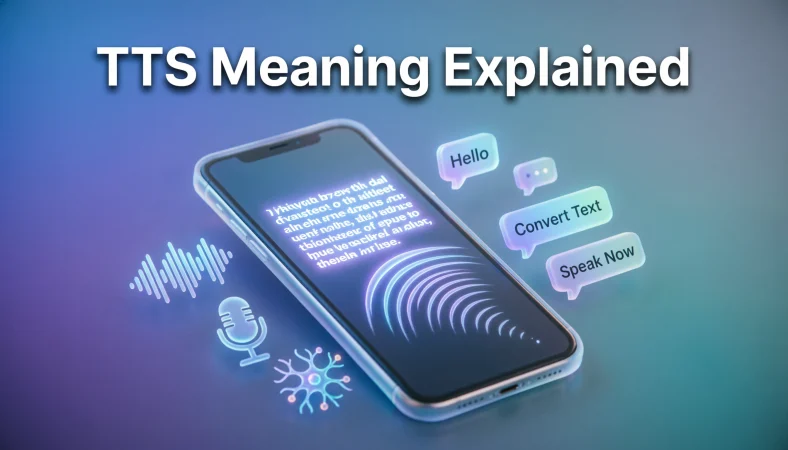

TTS meaning stands for “Text-to-Speech.” It refers to a technology that converts written text into spoken voice using software or AI-generated audio.
In simple terms, TTS allows computers, apps, or devices to “read aloud” text, making information more accessible, interactive, and engaging.
Imagine reading a long article while driving, listening to your messages hands-free, or turning your written content into engaging audio instantly. That’s exactly what TTS (Text-to-Speech) does and it’s rapidly becoming a core part of modern digital experiences.
From accessibility tools for visually impaired users to voice assistants, audiobooks, and social media content creation, TTS is everywhere. Whether you’ve used voice navigation, listened to an AI-generated podcast, or heard a robotic voice reading text, you’ve already experienced TTS in action.
In this guide, you’ll learn everything about TTS meaning, origin, real-world usage, examples, comparisons, and more all explained in a simple, human-friendly way.
What Does TTS Mean in Simple Terms?
TTS (Text-to-Speech) is a technology that converts written words into spoken audio using artificial or synthetic voices.
Key Points:
- Converts text → voice
- Used in apps, devices, and software
- Can sound robotic or highly realistic (AI voices)
Origin and Evolution of TTS
The concept of text-to-speech isn’t new it dates back to early computing experiments in the 1960s. Back then, speech synthesis sounded extremely robotic and unnatural.
Evolution Timeline:
- 1960s–1980s: Basic synthetic speech (robot-like voices)
- 1990s–2000s: Improved clarity with digital voices
- 2010s: Integration into smartphones and assistants
- 2020s+: AI-powered voices that sound almost human
Today, advanced TTS systems use deep learning and neural networks to mimic natural speech patterns, emotions, and accents.
Why Is TTS So Popular Today?
TTS has exploded in popularity due to technology advancements and changing user behavior.
Key Reasons:
- 📱 Mobile usage: Hands-free content consumption
- 🎧 Audio content boom: Podcasts, audiobooks, reels
- ♿ Accessibility: Helps visually impaired users
- 🤖 AI growth: Realistic human-like voices
- ⚡ Convenience: Multitask while listening
How TTS Is Used in Real Life
TTS is not just a tech term, it’s part of daily life.
Common Use Cases:
1. Voice Assistants
- Reading weather, messages, reminders
2. Audiobooks
- Converting books into audio format
3. Navigation Systems
- Turn-by-turn voice directions
4. Social Media Content
- AI voiceovers for videos (TikTok, YouTube Shorts)
5. Accessibility Tools
- Screen readers for visually impaired users
6. E-Learning
- Narrating lessons and study materials
Examples of TTS in Context
Here are some real-world examples showing how people use TTS:
| Scenario | Example Sentence | Tone |
| Friendly | “I used TTS to listen to my notes while jogging 🎧” | Casual |
| Neutral | “This app supports TTS for reading documents aloud.” | Informational |
| Professional | “Our platform integrates TTS for enhanced accessibility.” | Formal |
| Excited | “This AI TTS voice sounds so real! 😲” | Enthusiastic |
| Slightly Negative | “The TTS voice sounds too robotic.” | Critical |
Different Types of TTS Voices
Not all TTS voices sound the same. There are different categories:
1. Basic Synthetic Voices
- Robotic tone
- Limited expression
2. Concatenative TTS
- Uses recorded human speech segments
3. Neural TTS (AI-based)
- Natural, human-like voice
- Can include emotion and tone
TTS vs Related Terms (Comparison)
People often confuse TTS with similar abbreviations. Here’s a clear comparison:
| Term | Full Form | Meaning | Difference |
| TTS | Text-to-Speech | Converts text into voice | Output is audio |
| STT | Speech-to-Text | Converts voice into text | Opposite of TTS |
| ASR | Automatic Speech Recognition | Recognizes spoken language | More advanced STT |
| Voice AI | AI-powered voice tech | Broader category | |
| Narration | Human voice reading text | Not automated |
Alternate Meanings of TTS
While Text-to-Speech is the most common meaning, TTS can have other meanings depending on context:
Other Possible Meanings:
- TTS (Time to Spill) – Used in casual chats
- TTS (True to Size) – Common in online shopping
- TTS (Tourist Trophy) – Refers to a motorcycle race
👉 Always check the context to understand the correct meaning.
When Should You Use TTS?
TTS is useful in many situations:
Best Use Cases:
- Listening instead of reading
- Creating voice content quickly
- Making content accessible
- Multitasking (driving, exercising)
Polite or Professional Alternatives to TTS
If you’re writing formally or explaining to beginners, you might prefer:
- “Text-to-Speech technology”
- “Automated voice narration”
- “Speech synthesis system”
- “AI voice generator”
Tips for Using TTS Effectively
To get the best results from TTS:
- ✔ Choose a natural-sounding voice
- ✔ Adjust speed and tone
- ✔ Use proper punctuation for better speech flow
- ✔ Break long text into shorter chunks
- ✔ Test different voices for your audience
Common Mistakes to Avoid
- ❌ Using robotic voices for professional content
- ❌ Ignoring pronunciation errors
- ❌ Overusing TTS without editing
- ❌ Not checking tone consistency
FAQ:
1. What does TTS stand for?
TTS stands for Text-to-Speech, a technology that converts written text into spoken audio.
2. Is TTS the same as AI voice?
Not always. TTS is the broader concept, while AI voice refers to advanced, realistic versions of TTS.
3. Where is TTS used?
It’s used in voice assistants, audiobooks, apps, navigation systems, and accessibility tools.
4. Is TTS free to use?
Some tools are free, while advanced AI TTS platforms may require payment.
5. Can TTS sound like a real human?
Yes, modern AI-based TTS can sound very natural and human-like.
6. What is the difference between TTS and STT?
TTS converts text to voice, while STT converts voice to text.
7. Is TTS useful for content creators?
Absolutely! It’s widely used for voiceovers in videos, podcasts, and social media.
8. Does TTS support multiple languages?
Yes, many TTS systems support multiple languages and accents.
Conclusion:
TTS, or Text-to-Speech, is more than just a tech feature; it’s a powerful tool shaping how we consume and interact with digital content. From improving accessibility to enabling hands-free experiences and enhancing content creation, TTS has become an essential part of modern life.
The biggest advantage of TTS is its flexibility. Whether you’re a student, professional, or content creator, it allows you to turn written information into engaging audio effortlessly.
As AI continues to evolve, TTS voices will only become more realistic, making this technology even more impactful in the future.