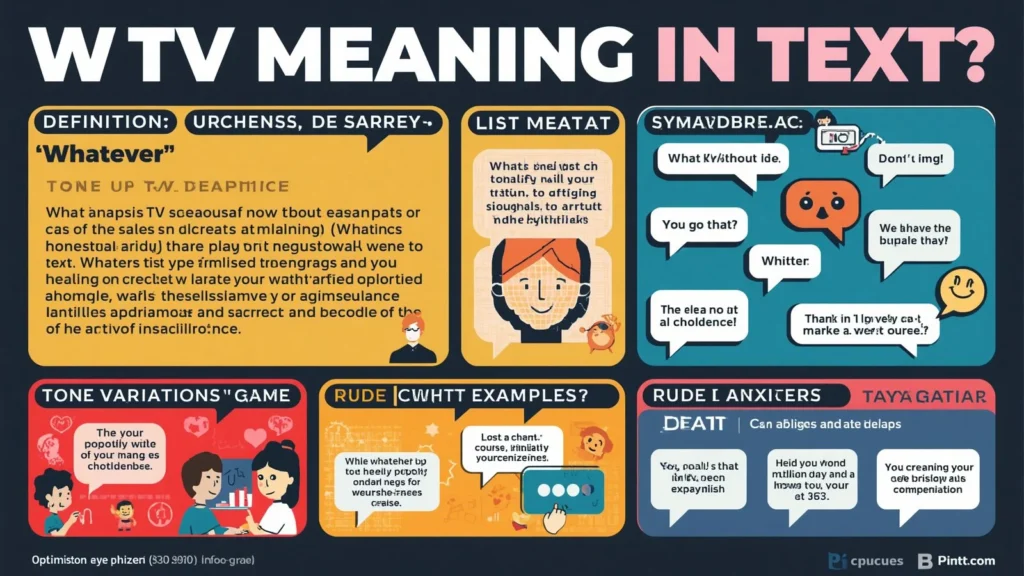

WTV is a casual internet slang abbreviation that stands for “whatever.” It is commonly used in text messages, social media, and online chats to express indifference, agreement, dismissal, or lack of interest, depending on the context and tone.
If you’ve spent even a few minutes scrolling through chats, TikTok comments, or Snapchat messages, chances are you’ve come across “wtv.” It’s short, quick, and packs a surprising range of emotions into just three letters.
But here’s the catch: “wtv” doesn’t always mean the same thing. Sometimes it’s chill and relaxed. Other times, it can come off as cold, dismissive, or even a little rude.
So what does “wtv” really mean in text? When should you use it and when should you avoid it?
In this complete guide, you’ll learn everything about the wtv meaning in text, including tone, examples, comparisons, and professional alternatives.
What Does WTV Mean in Text?
At its core, “wtv” = “whatever.”
However, its meaning changes based on context, tone, and relationship between people.
Common Meanings of WTV
- Indifference: “I don’t really care”
- Agreement: “That’s fine with me”
- Dismissal: “I’m done with this conversation”
- Casual response: “Anything works”
Origin and Rise of “WTV”
Where Did WTV Come From?
“WTV” evolved from the word “whatever,” which became popular slang in the 1990s. Over time, as texting and internet culture grew, people started shortening words to type faster.
Why It Became Popular
- Faster typing on phones 📱
- Social media character limits
- Casual communication style
- Popular among Gen Z and younger millennials
Where You’ll See It Most
- WhatsApp chats
- Instagram comments
- Snapchat messages
- TikTok captions
- Gaming chats
How WTV Is Used in Real Life (With Tone Breakdown)
The meaning of “wtv” depends heavily on tone. Let’s break it down into the most common usage styles:
1. Friendly / Casual Tone 😊
Used when you’re relaxed and open.
Example:
- “We can watch a movie or go out, wtv works!”
👉 Meaning: I’m easy, anything is fine.
2. Neutral Tone 😐
Used when you genuinely don’t mind either way.
Example:
- “Pick the restaurant, wtv.”
👉 Meaning: Your choice, I don’t have a preference.
3. Dismissive / Annoyed Tone 🙄
Used when you’re frustrated or uninterested.
Example:
- “Wtv, do what you want.”
👉 Meaning: I don’t care anymore.
4. Argument or Conflict Tone ⚠️
Used to end a conversation abruptly.
Example:
- “Wtv. I’m done arguing.”
👉 Meaning: I’m disengaging (possibly annoyed).
Example Table: WTV in Different Contexts
| Scenario | Text Example | Meaning | Tone |
| Planning with friends | “We can eat pizza or burgers, wtv” | Flexible choice | Friendly |
| Decision making | “Wtv you think is best” | Trusting someone else | Neutral |
| Mild frustration | “Wtv, it doesn’t matter” | Slight annoyance | Negative |
| Argument | “Wtv. I don’t care anymore.” | Dismissive ending | Strongly negative |
When to Use “WTV” (And When Not To)
✅ Use WTV When:
- Chatting casually with friends
- You truly don’t have a preference
- Keeping conversations light and informal
❌ Avoid WTV When:
- Talking to your boss or clients
- Writing emails or professional messages
- Discussing serious or emotional topics
- You don’t want to sound rude
WTV vs Similar Slang Terms
“WTV” isn’t the only slang word with flexible meaning. Here’s how it compares:
| Term | Full Form | Meaning | Tone |
| WTV | Whatever | Flexible / dismissive | Depends on context |
| IDC | I don’t care | Clear indifference | Often blunt |
| IDK | I don’t know | Lack of knowledge | Neutral |
| K | Okay | Short acknowledgment | Can feel cold |
| Meh | Unimpressed / indifferent | Casual negative |
Key Difference
- WTV is more flexible, but also more ambiguous
- It can sound friendly or rude depending on delivery
Alternate Meanings of WTV (Less Common)
While “whatever” is the main meaning, “wtv” can sometimes stand for:
- “What’s the vibe” (rare, slang-specific context)
- “What to view” (used occasionally in content discussions)
👉 These meanings are uncommon, so in most cases, assume “whatever.”
Polite and Professional Alternatives to WTV
If you want to sound more respectful or clear, here are better options:
Casual but Polite
- “Anything works for me”
- “I’m okay with either option”
- “Your choice!”
Professional Settings
- “I’m flexible with the decision”
- “Please proceed with what you think is best”
- “I have no strong preference”
Pro Tips for Using WTV Correctly
- Add context to avoid confusion
- ❌ “wtv”
- ✅ “wtv works for you 😊”
- Use emojis to soften tone
- “wtv 🙂” feels friendly
- “wtv.” feels cold
- Avoid in arguments unless intentional
- It can escalate tension quickly
- Know your audience
- Fine for friends, risky for formal communication
Real-Life Conversation Examples
Friendly Chat
A: “Should we meet at 6 or 7?”
B: “Wtv works!”
👉 Relaxed and easygoing
Neutral Response
A: “Which movie?”
B: “Wtv you pick.”
👉 No strong opinion
Slightly Annoyed
A: “You always do this!”
B: “Wtv…”
👉 Disengaging emotionally
Argument Ending
A: “You’re wrong!”
B: “Wtv. I’m done.”
👉 Conversation shutdown
FAQ:
1. What does WTV stand for in texting?
WTV stands for “whatever.” It expresses indifference, flexibility, or dismissal depending on context.
2. Is WTV rude?
It can be. In casual chats, it’s fine. But in arguments or serious conversations, it may sound dismissive.
3. Is WTV the same as “I don’t care”?
Not always. WTV can mean “anything works,” while “I don’t care” is more direct and blunt.
4. Can I use WTV in professional messages?
No, it’s best to avoid it. Use polite alternatives like “I’m flexible” instead.
5. What tone does WTV usually have?
It depends on context:
- Friendly → relaxed
- Neutral → indifferent
- Negative → dismissive
6. Why do people use WTV instead of “whatever”?
It’s shorter, faster, and fits casual texting culture.
7. Does punctuation change the meaning of WTV?
Yes:
- “wtv 😊” → friendly
- “wtv.” → cold or annoyed
8. Is WTV used worldwide?
Yes, especially in English-speaking online communities and among younger users globally.
Conclusion:
In conclusion, WTV is a casual, shorthand expression commonly used in texting and online chats to mean “whatever.” It conveys indifference or a relaxed attitude toward a situation, decision, or opinion.
While simple, its tone can vary depending on context from playful and lighthearted to dismissive. Understanding its usage helps you communicate more naturally in informal digital conversations.
Final Tip
If you’re unsure how it might be received, spell it out or use a clearer phrase. A small change can make your message feel much more respectful and understood.