
The leap from a dorm room brainstorm to a viable startup isn’t just paved with code, financial spreadsheets, or late-night coffee sessions; it is built on the power of the spoken word. For the modern undergraduate, the ability to articulate a vision clearly and passionately is the ultimate competitive advantage. In an era where technical skills are increasingly commoditized by automation and AI, the “soft skill” of public speaking has become the “hard currency” of the global business world.
Entrepreneurship is, at its core, an act of persuasion. You are persuading investors to part with their hard-earned capital, persuading top-tier talent to join a risky mission, and persuading skeptical customers that your specific solution solves their most pressing pain points. When students master the art of the podium, they aren’t just learning how to give a class presentation; they are learning how to lead organizations.
However, the path to leadership is often cluttered with the heavy demands of university life. The pressure of maintaining high grades while simultaneously launching a venture can be an overwhelming mental burden. Many ambitious founders realize that i need help with an assignment is a strategic move, allowing them to delegate routine or highly technical tasks to professionals so they can focus their energy on the high-stakes communication required to scale their business. This balance is the hallmark of a successful manager: knowing which tasks to execute personally and which to delegate for the sake of the bigger picture.
The Intersection of Rhetoric and Revenue
Why does public speaking correlate so highly with entrepreneurial success? It’s about a concept often called “Founder’s Presence.” When a student entrepreneur stands in front of a room—be it a classroom, a boardroom, or a local networking event—their delivery dictates the perceived value of their entire idea. If the speaker is hesitant, the product seems unfinished. If the speaker is confident, the product seems revolutionary.
1. Building Instant Credibility
In the early stages of a startup, there is very little data to go on. Investors don’t just invest in ideas; they invest in people. A student who can command a room signals emotional intelligence, resilience, and competence. Public speaking forces you to own your space, a trait that translates directly into the “authority” needed to close deals.
2. Simplifying the Complex
Innovation often involves complex systems—software, biotechnology, or intricate logistics. The best entrepreneurs are those who can perform “intellectual translation.” They take a convoluted technical problem and explain it in a way that a five-year-old—or a venture capitalist—can understand instantly. If you can’t explain your business in sixty seconds, you don’t understand it well enough to run it.
3. Storytelling as a Sales Tool
Facts and figures tell a story, but narratives sell a vision. Public speaking teaches students how to wrap their data in a human-centric narrative. Instead of saying “Our app has a 20% faster interface,” a trained speaker says, “We save the average student two hours a week—time they can spend on their dreams instead of their screens.” This emotional resonance is what builds brand loyalty.
Strategic Communication: The Founder’s Toolkit
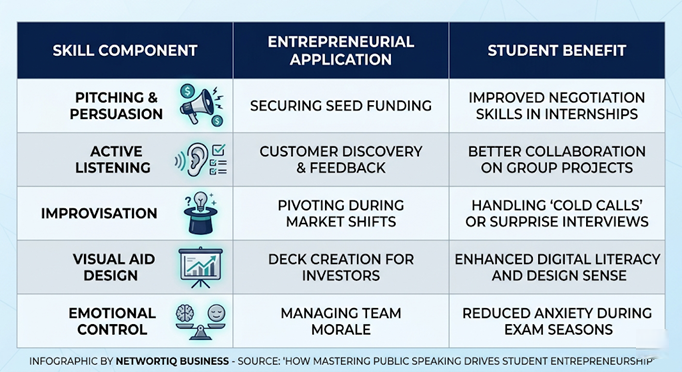
Mastering the stage requires a specific set of tools that mirror the needs of a growing business. Undergraduate students often struggle with the transition from academic writing—which is often dense and citation-heavy—to professional speaking, which must be lean and impactful.
| Skill Component | Entrepreneurial Application | Student Benefit |
| Pitching & Persuasion | Securing Seed Funding | Improved negotiation skills in internships |
| Active Listening | Customer Discovery & Feedback | Better collaboration on group projects |
| Improvisation | Pivoting during market shifts | Handling “cold calls” or surprise interviews |
| Visual Aid Design | Deck Creation for Investors | Enhanced digital literacy and design sense |
| Emotional Control | Managing Team Morale | Reduced anxiety during exam seasons |
Crafting the “Founder’s Intro”
One of the most critical moments for any student entrepreneur is the first sixty seconds of an encounter. Whether you are at a networking mixer, a career fair, or a formal pitch competition, your “hook” determines your trajectory. You never get a second chance to make a first impression, and in the fast-paced world of business, those first few sentences act as a filter.
Many students over-complicate this. They focus on their title or their GPA rather than the value they bring to the table. However, by practicing a structured self introduction speech, you ensure that you leave a lasting impression that goes beyond just your name. At MyAssignmentHelp, the focus is often on helping students refine these professional communications so they can transition seamlessly from the classroom to the boardroom. A well-crafted introduction isn’t just about reciting a bio; it’s about identifying a specific problem in the market, offering a unique solution, and stating your “why” in a way that invites further conversation. When you nail this intro, you aren’t just a student; you are a solution-provider.
Overcoming the “Stage Fright” of Innovation
Glossophobia—the fear of public speaking—is often cited as the number one fear among young adults. For a student entrepreneur, this fear can be a literal “innovation killer.” If you are too afraid to speak about your idea, the idea dies in your notebook.
The global business landscape doesn’t wait for the shy or the hesitant. To overcome this, students should view public speaking as a muscle rather than a natural-born talent. You don’t “have” charisma; you build it through repetition and feedback.
- The “Low-Stakes” Entry: Don’t wait for a $10,000 pitch competition to start speaking. Practice your pitch in student clubs, at the dinner table, or even in front of a mirror.
- The Video Audit: It is notoriously uncomfortable to watch yourself on video, but it is the fastest way to improve. You will notice “filler words” (like “um” and “like”), closed body language, or a lack of eye contact that you weren’t aware of in the moment.
- Audience-Centric Thinking: Shift the internal narrative from “How do I look?” to “How can I help these people understand this value?” When you focus on serving the audience, your ego—and your anxiety—diminishes.
The Global Tone of Modern Business
In today’s interconnected economy, student entrepreneurs aren’t just competing with the person in the next dorm; they are competing with founders in London, Bangalore, Sydney, and Toronto. This requires a “global tone” in communication. This means being clear, avoiding overly local slang, and understanding the cultural nuances of persuasion.
Public speaking teaches you to read a room. It teaches you when to lean in for emphasis and when to pause for effect. These are the same skills needed to manage a remote team across different time zones or to negotiate with a supplier from a different cultural background. As your business grows, your role shifts from “doing” to “communicating.” A student who can lead a seminar discussion today is the CEO who can lead a global town hall meeting tomorrow.
The Scalability of Voice
In the digital age, public speaking has expanded far beyond the physical stage. It now encompasses webinars, LinkedIn video content, podcasts, and Zoom pitches. The medium might change, but the core principles of rhetoric—Ethos (credibility), Pathos (emotion), and Logos (logic)—remain the foundation of every successful brand.
By investing in your voice now, you are building a platform that can scale with your business. A founder who can speak well is a founder who can market for free. Every podcast appearance, every guest lecture, and every networking event becomes a marketing channel that costs nothing but time and breath.
FAQ: Empowering the Student Voice
Q: How can I balance public speaking practice with a heavy course load?
Ans: Efficiency is key. Treat every class presentation as a “beta test” for your entrepreneurial style. Don’t just “get through it”—use it to practice your eye contact and vocal variety. Additionally, delegating time-heavy research tasks or formatting work can free up the mental space needed to focus on your performance and delivery skills.
Q: Does public speaking really help if I’m running an online-only business?
Ans: Absolutely. Even “faceless” businesses require high-level communication. You will need to record voice-overs for ads, pitch to potential partners over video calls, and potentially interview candidates for your team. Your voice is often the only human element in a digital business.
Q: What is the most common mistake students make in a self-introduction?
Ans: Talking too much about their past and not enough about the future. A great intro is a bridge. It should briefly mention where you’ve been, but focus primarily on the problem you are currently solving and why the person listening should care.
Q: How do I handle a “Q&A” session if I don’t know the answer to a technical question?
Ans: Integrity is more important than appearing omniscient. If you don’t have the data, admit it. Say, “That’s a brilliant point that we are currently analyzing. I don’t have the exact figure on me, but I can follow up with you this afternoon with the data.” This builds more trust than a fabricated or “vague” answer.
Q: Can introverts be good public speakers?
Ans: Some of the greatest speakers in history were introverts. Public speaking is a performance, not a personality trait. Introverts often excel because they tend to be more prepared and are excellent observers of audience behavior.
About The Author
Hello, I’m Alice Anderson. As a Senior Content Strategist and Academic Consultant, I specialize in bridging the gap between rigorous university standards and the practical needs of modern students. My work focuses on developing SEO-driven content strategies that prioritize expertise and trustworthiness to help students navigate complex educational landscapes.

